The Planning
|
This project evolved from the project a wrote about in the course I took for this program (link right). I was having a hard time figuring out what my students could make, that also incorporated geometry content. I googled some ideas, and I thought that having them make a sculpture would be fun, and not too challenging for my first Maker Education project. I was right and wrong about this.
|
I was right about this because geometry is so easy to bring making into, there are 1-3 units on measurement.
I was wrong because Shelly asked "What if... you did this project across multiple units"
And so the Living Sculpture was born.
I was wrong because Shelly asked "What if... you did this project across multiple units"
And so the Living Sculpture was born.
|
At first I was going to have this project span across the entire second semester, but then I moved schools. Since I was getting new students in the middle of the year, and I did not know their work ethic or mindset about math, I decided to just have this project cover Quadrilaterals, Area of 2D Figures, and Surface Area and Volume of 3D figures.
|
Since I knew what units I wanted this project to cover, I had to start figuring out what exactly I wanted them to do. This was more challenging, mostly because I had no idea what I wanted my students to make, other than a sculpture out of cardboard, which is not a very detailed starting point. There were a few things that I did know for sure, though:
- This would be an individual project. I wanted every student to make something that was meaningful to them, NOT their partner.
- I wanted them to write about the process of Making, as well as the math that they were learning about and incorporating into their project.
- I wanted this to be as open ended as possible.
The Launch
|
|
OrigamiI wanted all of my students to be able to reflect on the process of Making something after that first day. In order for this to happen, we needed have a small Maker Activity. I decided to have my students make an origami bird. To the left are pictures of their birds. I think it was successful because most students found something challenging about making the birds, but everyone was able to have a piece of paper that resembled a bird in the end.
These are the supplies I used:
|
Learning about the Maker Movement
Before my students could be successful in this project, they needed to learn about the movement they were about to be a part of. The only issue is that I could not find any student friendly articles or videos that explained what the Maker Movement was and why it was important. The best thing I could find was this article, but it was way too long, so choose excerpts to tell the students about this movement.
Learning about the Growth Mindset
I gave my students the option to read this article about the Growth Mindset, or watch this video from Khan Academy. I like both of these because they are made for students in mind. Both sources give the same information, but the students had a choice to read or watch, and I have a high population of ELL's, so I thought this was important.
Google Forms
I had students complete 3 different surveys. One was to help me get to know them and what interested them. It had a lot of questions, maybe too many.
I intended to use the other two surveys to make wordles about what the students said Making and the Growth Mindset was. Not enough students filled these out, so I was not able to make wordles.
I intended to use the other two surveys to make wordles about what the students said Making and the Growth Mindset was. Not enough students filled these out, so I was not able to make wordles.
Art that Inspires
In order for my students to get into the mindset of being artists, I wanted them to look at art for art that inspires them. I gave them 6 places they could look, but also encouraged them to look other places for inspiring art.
|
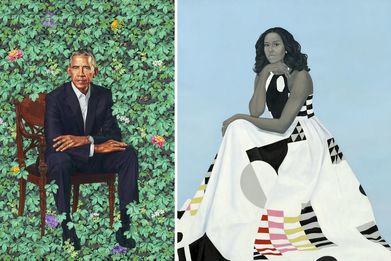
I had a few students find art outside of the resources that I provided. One student choose the official portraits of Barack and Michelle Obama. She is black and found it inspiring that the Obama's choose black artists to make their portraits. She also appreciated that these do not look like previous presidential portraits.
|
|
|
|
Another student choose art by different artists who were told to stop because what they were creating was impossible or scary, but they did not give up. Because they did not give up, we have Starry Nights by Vincent van Gogh and successful films by Tim Burton.
|
The Math Content
For this project, I covered the following topics. For topics that I had investigations, I wrote a blog post about, which is linked.
- Properties of Quadrilaterals
- Area of Triangles, Parallelograms, Trapezoids, Kites, and Rhombi
- Area of Regular Polygons, Circles, Sectors, and Composite 2D figures
- Surface Area of Prisms, Cylinders, Pyramids Cones, and Composite 3D figures
- Volume of Prisms, Cylinders, Pyramids, Cones, and Composite 3D figures
The Writing
One of my professional goals is to have students write about the math that they are learning. I had my first opportunity to do this as I was rolling out my Maker Project with my students. I had my students do this through Google Classroom, and I created Google Form Rubrics to fill out. These Google Forms would send an email to the student with all of my feedback, you just need to download this add-on for Google.
I based my rubrics off of the Single Point Rubric, after reading this article about the three most common rubrics. It then lead me to this article that explained the Single Point Rubric more. I choose to use the Single Point Rubric because the Analytic Rubric seemed too structured and Holistic Rubric was not structured enough. I wanted to give my students a guide to how to do well, but I did not want to give them a checklist to a 100%. I also wanted to make it easier/more important for myself to give the students written feedback.
After the launch of this project, I had students reply to the following prompts, which aligned to the stamp sheet linked above.
I based my rubrics off of the Single Point Rubric, after reading this article about the three most common rubrics. It then lead me to this article that explained the Single Point Rubric more. I choose to use the Single Point Rubric because the Analytic Rubric seemed too structured and Holistic Rubric was not structured enough. I wanted to give my students a guide to how to do well, but I did not want to give them a checklist to a 100%. I also wanted to make it easier/more important for myself to give the students written feedback.
After the launch of this project, I had students reply to the following prompts, which aligned to the stamp sheet linked above.
|
First Journal Prompt:
|
I also prepared a journal prompt that the students would respond to every week. I tried to word my questions carefully, so that students could not respond with "nothing" to the first question. I also want students to explain why. Why do they believe that they learned something, why do they believe that they did not learn something. My goal is for them to really reflect on their learning and to really understand how they learn. There are some students who understood this, but there were many who did not. I based some of my questions off of this blog post on Kindling Fires, and I think I'm going to change to be more like it next year.
|
Weekly Journal Entry Prompt:
|
After a couple weeks of the first weekly prompt, I read this blog post on Math = Love. Sarah Hagan talks about how she has so many students ask her what their grade is, and what missing assignments they have, that she put together a worksheet for systematically and consistently check their grades. I too have the same issue with students, so I added a couple questions to the beginning of their journal entries. I also broke it up because I had a few students who mixed up the questions about math and the project.
|
Weekly Journal Entry
Current Grades:
Mathematical Concepts:
Living Sculpture:
|
The final journal entry was right before their finals, so I wanted them to reflect on the year and their learning.
|
Mathematical Concepts:
Year Reflection, choose 3 questions to answer:
|
A lot of my students are English Language Learners (ELL's), and there are quite a few who are in the beginning/intermediate levels of their English Language Proficiency. I did not want them to be discouraged to complete the writing. This is one of the reasons why I do not grade on how they write. I also believe that I am not qualified enough to grade how students write. I mostly care about what they write about. I encourage students to use complete sentences, and I will comment on their lack of complete sentences in my feedback, but I will not take off. Like the students say, this is not English class, and as long as their writing about math, I consider that a win.
The Making
|
|
After we learned about the properties of quadrilaterals, students knew about most of the shapes we would cover for this project. I then had them draw their first draft of what they wanted their sculpture to look like. Many students took a long time, mostly because they had no idea about what inspired them.
There was one student, who mostly sleeps in my class, but when I had them do this, she came up to my desk and asked for help on what to draw. I had noticed that she drew a lot, when she was not sleeping, and asked her what she draw. She said she liked to draw people, so I told her that she should draw a person, with a geometric twist on it. So she did, and it is beautiful, I cannot wait for her to tweak her design and have it come to life. |
I gave students 4 block class days to work on their sculpture and presentation. Most of them were engaged in Making process. There were a couple students who I cannot get to do Geometry homework, but they were working on their sculptures, and they put together a presentation. It was very exciting to me to see how engaged these students were when they were doing something hands on and related to their interests.
One mishap on my part is that I did not teach them nets before we went over 3D figures. The Geometry PLC did not go over it, so I did not even think any thing of it, until they were trying to build their sculptures. There were students who wanted to make sail boats or rocket ships. They drew out their figures on cardboard, and cut it out exactly as they drew it, in one piece. They didn't understand what I was talking about when I asked them what shapes should there be. This is something that I must change when I do this project again.
Materials:
One mishap on my part is that I did not teach them nets before we went over 3D figures. The Geometry PLC did not go over it, so I did not even think any thing of it, until they were trying to build their sculptures. There were students who wanted to make sail boats or rocket ships. They drew out their figures on cardboard, and cut it out exactly as they drew it, in one piece. They didn't understand what I was talking about when I asked them what shapes should there be. This is something that I must change when I do this project again.
Materials:
- Cardboard (collected throughout the semester)
- Scissors, rulers, compasses, markers (already had)
- Hot glue guns ($9.69/bought 5)
The Product
|
What I enjoyed the most was how much I was getting to know some of them. I really got to see their interests come out in these projects.
Students were asked to put together a presentation that includes a description of why they chose to build what they did, the math in the sculpture, and a reflection of the most and least challenging parts of this project. Students presented to a small group of their peers at a time. The audience rotated and they had a rubric, attached to the right, that they had to fill out for each presenter. During one of the presentations, I overheard the best conversation. Presenter: I have trapezoids and rectangles. Evaluator: That's a square, not a rectangle. Presenter: No, the sides are not all the same length. This conversation was between two students who do not always pay attention in class, or do their homework. I was very excited when I heard the presenter back up why she believed her shapes were rectangles with mathematical reasoning. |
|
I had quite a few students who made houses, or asked me what would be easiest to make. Next time, I think I want to make a list where different shapes are given different point values. The "easier" the shape, the less points you get for it.
The Reflection
- Launch Day had a lot of parts to it. If I had stayed at my first school, it would not have because I went over the Growth Mindset during the first week of school. Next year, I plan to do the same thing.
- I had a lot of students who did not know what inspired them. After I launched my lesson, I found this article about Helping Your Students Identify Their Values by Maurice J. Elias. I had a survey that asked students questions about themselves, but I think it was too many questions. I will be using this article to help me get to know the students, but also for the students to get to know themselves at the beginning of the year.
- I want my students to write about their learning from the very beginning of the year. I want them to really get to know who they are as learners from the very beginning. I have many students who complain about writing in math class, but I hope that by having them do it from the very beginning, it will normalize writing in math.
- I need to teach students how to look at patterns to make conclusions. There were many times when all the students needed to to was read the questions in the document that they had and look at the patterns, but many of them needed me to do it with them.
- There was a lot of confusion in the beginning about what we were doing. I hope that next year, I will have examples of what I expect from them.
- My PLC did not talk about teaching nets at the beginning of the unit, so I did not think about it. This was a huge mistake. I just went with it this year, but next year I NEED to teach nets.
- I want to bring more math concepts into this sculpture. I would like to include similar and congruent triangles, more concepts about properties of quadrilaterals, and properties of circles.
- I would also like to weave the Making throughout this project. This year, my ideas for this project really formed after I told the students what we were doing, so I wasn’t able to bring Making into this project other than the end. I think I want students to create the shapes as we learn about them, and then find a way to put them together at the end.
- I do not think I integrated multiple units into this Maker project. I had the 2D and 3D units, but they are very similar. Next time, I'm going to have students cut out similar polygons, and integrate those into their sculpture, among other things.
The Resources
Readings to learn how to bring Making to your classroom
Resources for Maker project/lesson ideas
Technologies to use
Please use the buttons below or the links nested under the UTeach Maker tab above to navigate through my Showcase.
